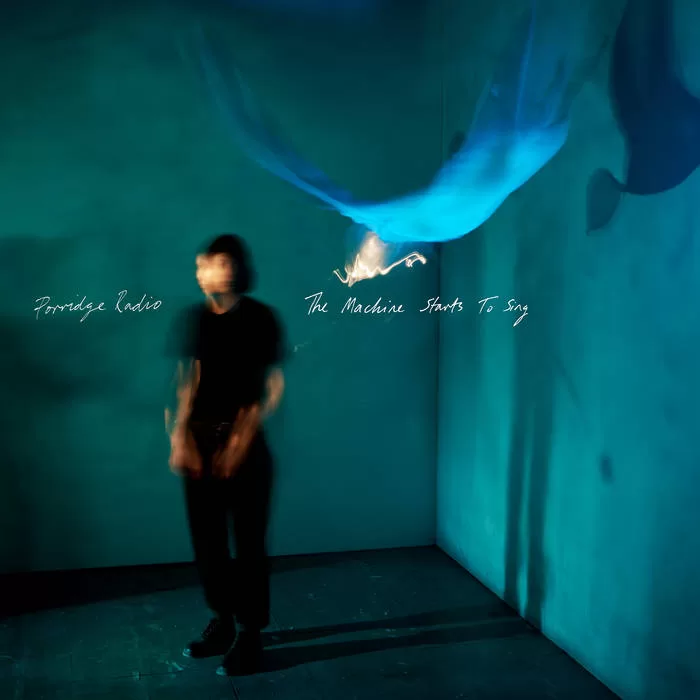

It is a strange thing to make sense of a breakup when the music arriving alongside it still sounds this restless, this unresolved, this unwilling to sit still. Porridge Radio‘s ‘The Machine Starts To Sing‘ arrives just months after ‘Clouds in the Sky They Will Always Be There for Me‘, an album we claimed was “a record that refuses to settle, constantly circling its own emotional pressure points without offering release”. This EP leans further into that instinct, sharpening it rather than stepping back.
That is where the friction sits. Dana Margolin still sounds like she is working something out in real time, looping phrases, pressing them until they shift shape. The band follows closely, adjusting rather than anchoring. For a supposed final release, there is a notable lack of closure. Instead, everything feels mid-thought, like the next step was already forming before the decision to stop cut it off.
Opener “Machine Starts To Sing“ is the centrepiece in every sense. It begins quietly, a hum and a strum that unfurls slowly, Margolin‘s voice subdued but loaded. The imagery is oblique and unsettling, the kind of lines that land before you have fully processed them. Around the five-minute mark, the whole thing shifts, guitars growing serrated and jagged, drummer Sam Yardley driving the band into controlled chaos while bassist Dan Hutchins wanders freely beneath it all. It is six minutes that earn every second.
“OK“ provides the sharpest contrast, a soft acoustic shuffle that feels almost startlingly direct by comparison. Margolin leans confessional here, her delivery loose and immediate, as if captured mid-thought. The nursery rhyme simplicity of her imagery lands with unexpected weight, and a repeated “no, no, no” in the chorus manages to carry more emotional freight than a full verse might. Brief, unguarded, and quietly devastating.

“Don’t Want To Dance“ pulls back toward the sonic territory of ‘Clouds in the Sky’, its melody carrying echoes of that album’s closing stretch. Margolin‘s voice cracks and wrenches at the phrasing, but what is most striking is the restraint. The backing vocal creates an eerie doubling effect, drawing attention inward. Where earlier Porridge Radio material might have tilted into rage or collapse, this holds its ground with something closer to acceptance. It is one of the more quietly remarkable things the band has committed to record.
Closer “I‘ve Got A Feeling (Stay Lucky)” lands as a genuine surprise. The most buoyant thing in the Porridge Radio catalogue, it rides a sumptuous melody while Georgie Stott‘s keys lift and recede around Margolin‘s voice. The central question, what to do with your life, is met with a shrug that somehow feels earned rather than defeatist. After years of railing against love, loss, and the general difficulty of existing, Margolin sounds like she has arrived somewhere. Not resolved, but settled enough.
There are clear reference points, but Porridge Radio remain distinct, largely through that constant sense of instability, the feeling that any track could tilt without warning. The production remains close and unvarnished, keeping Margolin‘s voice front and centre, imperfections intact. Lyrically, the same focus on self-confrontation and persistence holds, but with a tighter grip on phrasing. Lines are repeated, tested, stretched, as if the band is trying to find their exact breaking point.
This makes the ending difficult to accept at face value. This is not a closing statement. It is movement, interrupted.
Still, something is fitting in that. Porridge Radio have always thrived in that space where nothing is fully resolved, where control and collapse sit side by side. ‘The Machine Starts To Sing‘ leaves them there, mid-thought, still mid-sentence. Not a tidy ending, but one that feels entirely on their terms.
TRACKS: