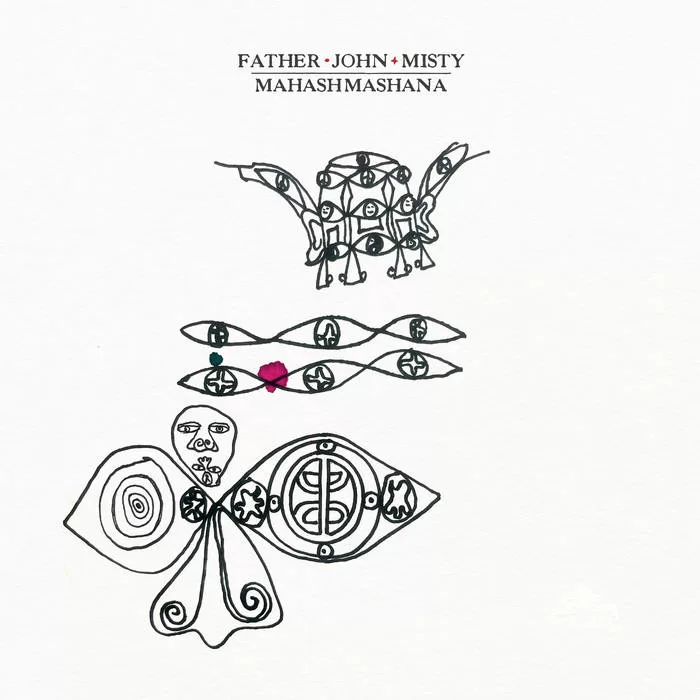

Before ‘Mahashmashana‘, I had often found myself on the fence with Father John Misty. Josh Tillman existed behind a carefully maintained distance, and it was genuinely unclear whether I was supposed to be laughing with him or being laughed at. I played the hell out of “Hollywood Cemetery Forever” and his acoustic version of Arcade Fire‘s “The Suburbs“ left me breathless. Still, I never felt fully invested in his albums as complete statements. There was always a wink, always a sense that the irony was doing more work than the sincerity. ‘Pure Comedy‘ offered apocalyptic satire. ‘God’s Favourite Customer‘ delivered raw heartbreak, but at arm’s length. Then came ‘Chloë and the Next 20th Century‘, which felt like costume play: technically brilliant, historically erudite, and somehow fundamentally hollow. A man trying on personas instead of excavating himself.
This latest album changes everything because our protagonist finally stops performing and starts confessing. Rather than tiptoeing around vulnerability, he smashes that fourth wall with a pickaxe. The Sanskrit title literally means “cremation ground,” and it signals his intent with ruthless clarity: this is a death album, a funeral for ego, ideology, and false certainties. More importantly, it’s the sound of an artist making genuine peace with what he has to say. This is easily one of the standout albums of the decade, and for me, a contender for the century so far. It’s that good.
Spanning 50 minutes across just eight tracks, the album’s greatest trick is refusing to outstay its welcome. That’s not a contradiction; that’s precision. You press play on the title track and “Mahashmashana“ arrives confessional and intimate, stripped of artifice. Here is the artist at his most vulnerable and philosophical, hopeful even amid the funeral rites. Drew Erickson‘s orchestrations feel less like grandeur and more like scaffolding for something deeply personal. When he sings about “perfect lies,” it cuts because the song itself refuses to hide behind them. This is the sound of an artist finally willing to be seen.
If the title track is the confession, “She Cleans Up” is the nervous laughter that follows. All groove and anxious energy, listen closely, and you’ll hear more than a subtle nod to Genesis’ “I Can’t Dance” in the rhythm and the melody of the chorus: the same syncopated pocket, the same melodic contour, whether intentional or not, creating a great Easter egg. The track has a wicked sense of humour lurking beneath its surface, a reminder that our FJM hasn’t abandoned wit, just weaponised it differently. It breaks the spell just enough to remind you this is a human record, not a monument.
“Josh Tillman and the Accidental Dose” arrives expansive and ambitious, delivered with a glint in the eye. All gorgeous instrumental languor and borderline sleazy storytelling, self-referential to the max and oozing cool. This sounds like Gainsbourg, confident in its own swagger. The production pulls back just enough to let the mischief breathe, creating a chamber-like atmosphere that feels like a confession whispered with a knowing smile. It’s the sound of an artist at full command of his powers, unafraid to seduce and transgress.
“Mental Health” sharpens the wit next. The line “no one knows you like yourself, maybe you two should speak” cuts with surgical clarity, a direct hit on the gap between our public performance and private reality. He trusts that his observations land hard enough to stand on their own. Then “Screamland“ launches as the album’s true high point, brooding and melancholic from its first moments. It builds and builds with Alan Sparhawk‘s crystalline guitar work helps to ground the album’s most vulnerable vocal performance, layering orchestration that accumulates like weight, and then delivers an incredible payoff in the choruses that hit with earned orchestral force. Transforming what could have been a breakable moment into something monumental, it anchors the album’s emotional centre perfectly.
“Being You” arrives next as something genuinely intimate and reflective, our protagonist retreating into a near-whisper to craft what feels like overhearing a private moment. But “I Guess Time Just Makes Fools of Us All” is where the album truly reveals its depths. This is the track I cannot get enough of, and it’s the centrepiece and everything else orbits around it. Beneath lush orchestral flourishes sits a disco groove, an earthy, grooving pulse that prevents the song from floating away into pure melancholy. He crafts intricate, wonderful storytelling across eight plus minutes, meditating on accumulated ambition, the lies we tell ourselves about maturity, the publicist conversations and career calculations that hollow us out. I could listen for another fifteen minutes because he’s finally saying something that matters: time doesn’t make us wiser, just older and more aware of the lies. This is the track I find myself returning to most, the one that deepens with each listen.
By the time you reach “Summer’s Gone“, something has shifted entirely. The closing track feels like a benediction, the artist sounding not resigned but reconciled. It serves as the album’s final statement: acceptance after all that rage and grief.
I can see myself returning to Mahashmashana for years to come, certainly throughout the coming months and beyond. It’s proof that artists can grow deeper into what matters rather than away from it. That pickaxe I mentioned earlier? It hit something real.
TRACKS: