
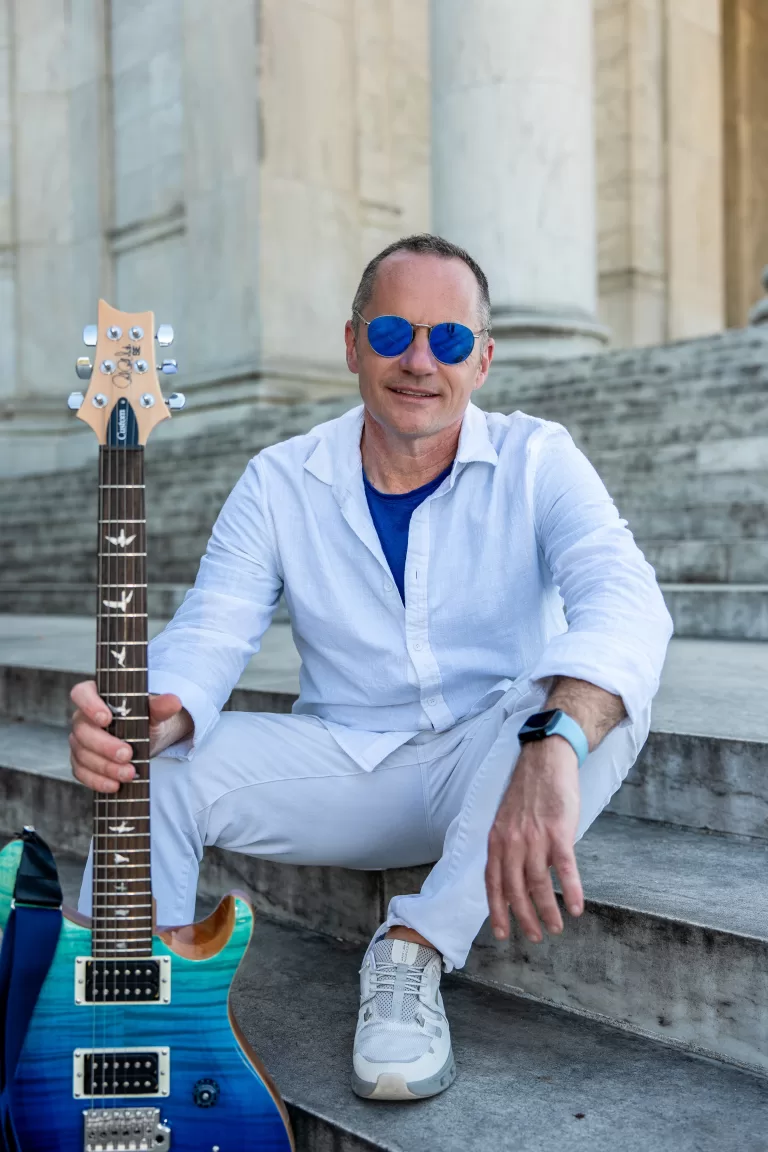

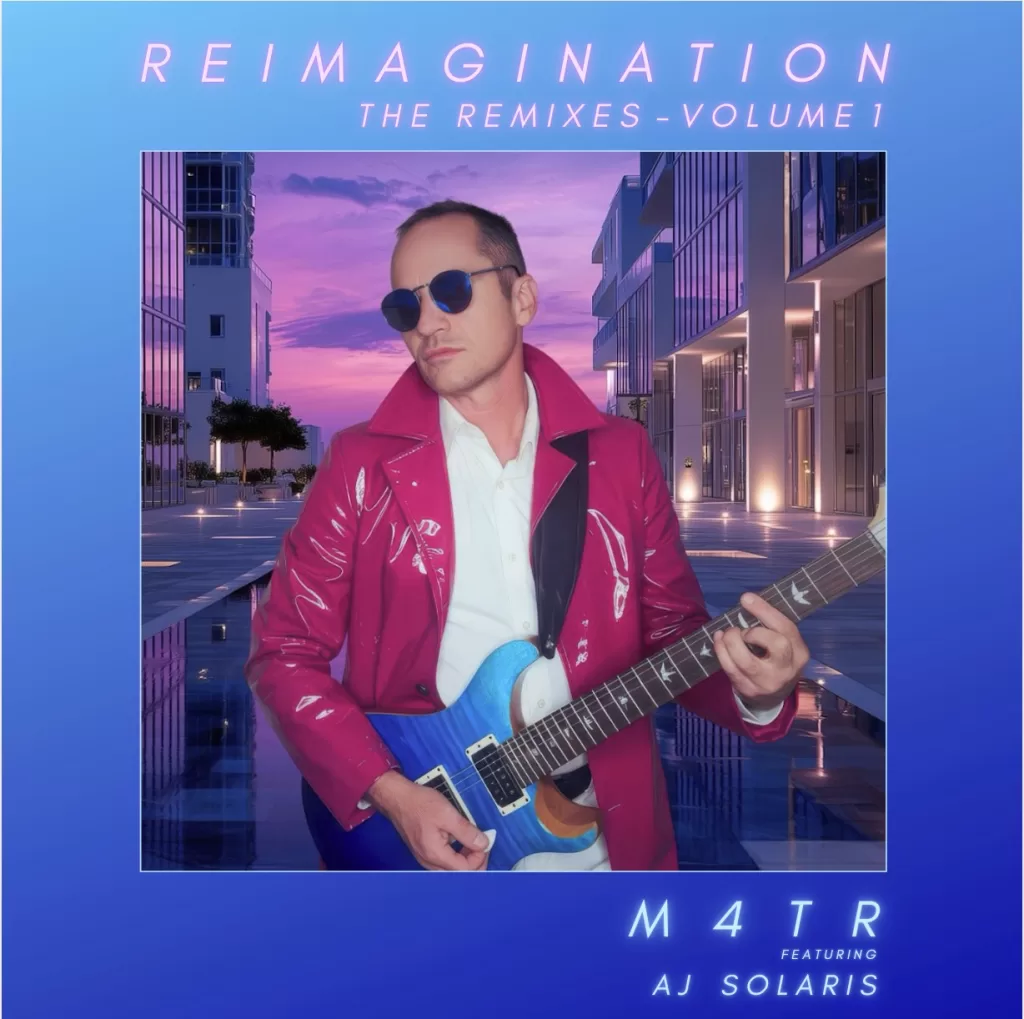
M4TR returns with ‘Reimagination: The Remixes, Vol. 1‘, a release that finds him handing key tracks from ‘Love Is The Revolution‘ over to Philip Larsen and Mr. Mig for a fresh pass. In the interview below, AJ Solaris talks about reinvention, the emotional core of the songs, the art of remixing, and what comes next.
Cougar Microbes: What’s a typical morning look like for you these days, especially with this remix series out in the world?
Typical morning: three cups of dark roast. I play something new on piano or guitar, walk my dog, rework polished demos I’m proud of, walk my dog, discover a new band, walk my dog. Those are my mornings.
CM: How would you sum up what M4TR is all about right now?
Reimagination isn’t a throwaway word. It’s about rediscovering the essence of songs by mining the depths of them, but also getting some distance and perspective by turning them over to talented engineers who bring fresh ideas.
Reimagination is another word for reinvention. After the last live band parted ways, I took some reflective time, released a 10-year retrospective digital box set on Bandcamp, navigated a health scare and suffered through writer’s block. This series, ‘Reimagination‘ Vols. 1 and 2 and the Complete collection, is breathing new life into my creative process. I’m very excited about the next phase. I’m also moving to Chicago, which I think will give the project a whole new life.
CM: If you had to pitch ‘Reimagination: The Remixes, Vol. 1‘ to a sceptical friend over coffee, what quirky hook would seal the deal?
Then I would quote from my song Hooks: “I can bait you with an earworm and a clever pun… now we’re singing it together in the summer sun.”
CM: Which track from the original versions are you most drawn back to lately, and what keeps pulling you in?
Philip Larsen’s take on Coup de Grace, the lead single off Vol. 1, is constantly playing on repeat. The song is about killing your enemies with kindness and choosing to take the high road. The song has three different beats and even a pre-chorus in half-time, so it wasn’t really conceived for the dancefloor, but Phil transformed it. It’s deeply funky. I’ve been closing a lot of street festival gigs with that version and it gets people moving every time. Vol. 2 will have many more bangers.
CM: What’s your guilty pleasure when you’re in that “good times for the end times” frame of mind?
There’s a new documentary about AI that coined the phrase “apocaloptimism.” Great word. My guilty pleasure is laughing at the absurdity of this planet and the fools running it, and dancing through dystopia anyway.
Songwriting & Recording
CM: Walk us through how a song usually begins for you. Does it start with a synth part, a lyric, a groove, or something harder to pin down?
It’s almost always the music first. A groove, a chord progression, a synth patch that takes me somewhere. I’ll finish the music, the melody and the demo months before I touch a single lyric. Once the groove is imprinted in my brain, I take it to a coffee shop and hunt for the words that fit the emotion and rhythm the music is already carrying. Usually, I write like Bernie Taupin and Elton John in reverse: I’m Elton first, laying down music, and then I become Bernie. The puzzle of matching language to a feeling that already exists in the chords is the part I love most.
Ironically, I’m working on a downtempo album called ‘On Winter’s Edge‘ now, and that method didn’t work at all because emotion was driving the music more than groove. So I reversed it and wrote the lyrics first to capture the raw emotion. Music is coming after. The best way to keep creating is to never commit to one method.
CM: ‘Love Is The Revolution‘ leans into things like obsession, regret, grief and connection. Was there one real-life moment that quietly found its way into one of these remixed tracks?
All of the tracks come from real-life moments I tried to bottle into something expressive for someone else to relate to. Just Out of Time is about how my college girlfriend made me feel when she dumped me three times. Fight The Good Fight is about playing to near-empty rooms with music friends. Polaris is about losing your North Star. In my life, that was my father at age 20 and later my grandmother. No Tomorrow is about how the attack on Ukraine brought back memories of growing up in the ’80s during the Cold War. Kill The Self is about a close friend I lost to toxic narcissism.
You’d think an album with these lyrics would be a downer, but they’re mostly dance tracks. With Mr. Mig and Philip Larsen, they’re club bangers. Most people don’t know they’re dancing to Cold War anxieties or mourning a toxic narcissist. Dance mixes flip the emotion even more.
CM: How did Coup de Grace or Hooks change once you started hearing them through the remix lens, or was there another track that surprised you even more?
The Spektre is about obsessive love from the viewpoint of a stalker or serial killer. And no, this is not from real life. Songwriting, like fiction, lets you put on a mask and play a part. But the remix version is so damn funky I can barely stand it. Very Peter Gabriel and Stevie Wonder to my ears, and I wrote a sax solo that I think punches through.
CM: What was one experiment in the studio with Philip Larsen or Mr. Mig that ended up unlocking something important in the song?
It was not so much an experiment as a mandate, which was to find a new foundation. That meant blowing up the live drums and bass and building a whole new groove. Phil is also great at finding these little analog synth Easter egg patches that feel like they were transported from the ’80s, arps à la Duran Duran, bass patches from the Pet Shop Boys and Wham. Little flairs of sonic nostalgia do it for me.
CM: How do you know when a remix is actually finished? Is it a technical thing, an emotional thing, or just a gut feeling that it finally clicks?
I’m pretty meticulous and a bit of a perfectionist on mixes, as former bandmates would tell you. But if you say to an engineer, here’s the basic structure, here are the stems I’d like to keep, and the rest is fair game, you’re simply waiting for a new song to reveal itself through their ears. It’s all things, technical, emotional and gut, but also visceral. I’m not a great dancer, but if the song dances me, then we’ve arrived.
Release-Specific
CM: These versions clearly push further onto the dancefloor, but they still seem to hold onto the feeling of the originals. What part of ‘Love Is The Revolution‘ did you most want to preserve in these reimaginings?
There’s a certain approach in my chord structures and melodies that I feel is unusual and not used much in modern music: parallel major and minor keys, Mixolydian, Phrygian and Lydian modes, substitute chords, spare use of the tonic chord. Same with lyrics: I like clever turns of phrase, dry wit, alliteration and what I’d generously call substandard rapping. These are all retained in the remixes.
To me, the mark of a good song is that it can work if you elevate the beat, and yet the melody and chords still shine through. And if you just play it on acoustic guitar by a campfire, it still works. A good song delivers across a wide range of stylings.
CM: The release moves between radio edits and extended versions. What did that format let you explore that a single version of each track wouldn’t?
Originally this was going to be an EP of extended mixes to pay homage to my favourite 12-inches from the era, Shep Pettibone, Daniel Miller, Trevor Horn, Phil Legg, Nile Rodgers and the like. To me, dance music is a bit like Sufi dancing, you’re supposed to lose yourself and surrender to it.
Sometimes that’s hard to do when monopolies like Spotify insist everything get shorter and shorter to please the algorithm. So I released both. But I prefer the longer mixes and always have. Going long was a small act of defiance. Fuck the algorithm.
CM: What surprised you most about handing your songs over to collaborators like Philip Larsen and Mr. Mig?
That I’ve spent a lot of my life, at least 10,000 hours in Logic Pro, mixing great demos that probably didn’t complete that last mile. I should have brought in this level of talent a bit earlier in the journey. I take on too much. Oh well, live and learn.
Live Shows
CM: From electrobusking to full band shows, what kind of atmosphere are you hoping to create when these remixes enter the live set?
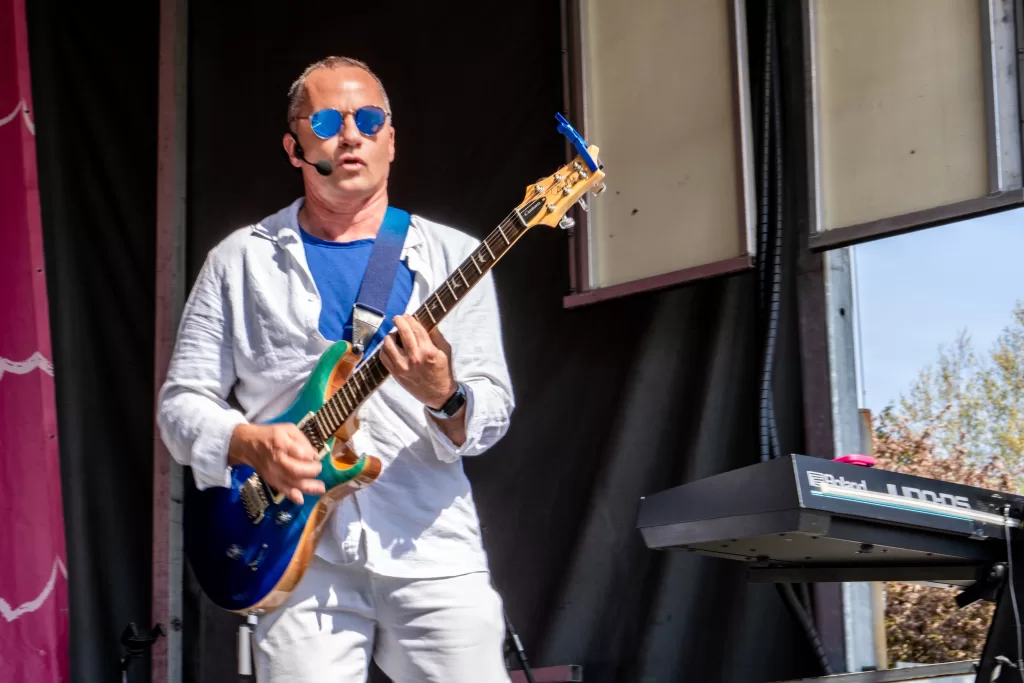
This new atmosphere is already happening. I’ve played a handful of festival shows with just myself and these remixes, and there’s just as much energy, if not more, than a full live band. But I want to bring in a female vocalist and maybe one or two other players so the live show can still be a bit unscripted down the road. Moving to Chicago this year, and I can’t wait to test it out there.
CM: Do you have any pre-show rituals, routines or odd little superstitions before going on stage?
Just try to express as much appreciation and gratitude in the green room as possible.
CM: How has your live setup evolved as the project has changed, especially when you’re trying to bring these bigger remix versions into a performance space?
I started performing wirelessly in 2022, inspired by David Byrne’s American Utopia. That will never change. I love being completely untethered so I can just jump into the crowd. I’ve got a pretty powerful JBL PRX One for the electrobusking, and it delivers a punch that respects the remixes just fine. Since it was released in April, I have yet to play it indoors. Can’t wait.
CM: You’ve played more than 100 gigs around the D.C. area. What strange habits, routines or survival skills have you picked up along the way?
I have adult ADHD and get flustered in the switchover between acts. I put orange duct tape on all my gear or I will lose it all. I also learned that when you play synth, keytar, electric guitar and acoustic, you take more time to set up than the drummer. I set my stopwatch for set-up and strike down like middle school track meets. I’ve got it down to eight minutes!
CM: Is there a song you’ve especially enjoyed remixing because it let you refresh the way you think about playing it live?
Pretty much all of Vol. 1 has been pure enjoyment. I am partial to Coup de Grace and Kill The Self. I’m also closing on the unreleased mix of No Tomorrow. Once I release all three discs, I’ll have a solid 80 to 90 minutes of the same quality. It’s brought a new joy to playing live for sure.
Musical Backstory
CM: What was the first tape or CD you bought with your own money, and do you feel any trace of that version of yourself in M4TR now?
I gave my dad money from my first summer job to buy bootlegs of Duran Duran on a business trip to Japan. Rio is sublime. You can hear Duran’s influence and many of their contemporaries throughout everything I put out.
CM: What’s the last song by someone else that got stuck in your head and refused to leave?
Chappell Roan’s Good Luck Babe. It’s like a computer virus.
CM: Who from the D.C. scene should people be paying more attention to right now?
I’m partial to Shelly Star, Ari Voxx, The Invisibles and Color Palette.
CM: Beyond music, are there films, books or other kinds of art that fed into the emotional or visual shape of ‘Love Is The Revolution‘ and these remixes?
On the side I have an ambient project called Arkolyte. I released my sophomore album ‘Arkolyte II‘ during this reflective period. No groove, no words, just atmosphere that transports. It’s the palette cleanser that lets me return to M4TR with fresh ears and fresh emotion. I think they are inspired by two of my favorite films, Baraka and Samsara. Unspoken world travel.
Open Scenarios
CM: If you could hand one M4TR track to any dream remixer, living or dead, who gets it and why?
Nile Rodgers. I saw him open for Duran Duran in 2022 at Merriweather Post Pavilion. He played Let’s Dance, We Are Family, Le Freak, I’m Coming Out, Good Times and Get Lucky, songs he co-wrote and remixed for others. I kind of felt sorry for Simon and the boys. But they were phenomenal too.
CM: When you think about success for ‘Reimagination: The Remixes, Vol. 1‘, what does that actually mean to you beyond numbers and streaming stats?
Look, I’m aiming for an analog revolution. I’m tired of data porn for self-validation. Obsessing over streaming stats is not good for the soul. Are those people listening to my music? Bots? Am I competing with AI songs? It’s all solipsism, completely unverifiable on a human level. The whole ecosystem has been enshittified.
I played these new remixes at Adams Morgan Porchfest in D.C. in April and people were dancing in the streets. That is success to me. I’d rather promote my music with flyers in dive bars and celebrate with the ladies dancing alongside me. Spotify Wrapped sends a Silicon Valley-inspired message very far away from the human soul.
CM: With Vol. 2 already on the horizon, what can you hint at about what’s coming next?
I’m going to reimagine for a bit longer, at least through summer 2027. Vol. 2 will be a strong sequel, if not stronger than Vol. 1. I’m also saving a couple of singles and extended mixes for the complete collection to close it out.
In addition to supervising the mixes, I need to wrap ‘On Winter’s Edge‘ so I can return to my social commentary roots with another album addressing AI and this political moment. I plan to do all of this in Chicago. It’s more fertile ground than D.C. at the moment. I moved here in 2008 when Obama became president. Living in D.C. was cool. It’s definitely less cool now. Downright depressing. I saw razorwire around the Capitol Building after January 6 for God’s sake. D.C. will get its mojo back. Part of my heart will always be there. Everyone likes a good comeback story.
It’s refreshing to hear an artist speak so plainly about process, emotion, and the value of letting songs breathe in new hands. Stay tuned for Vol. 2, due in September 2026, with the complete ‘Reimagination‘ collection to follow.
TRACKS:
