
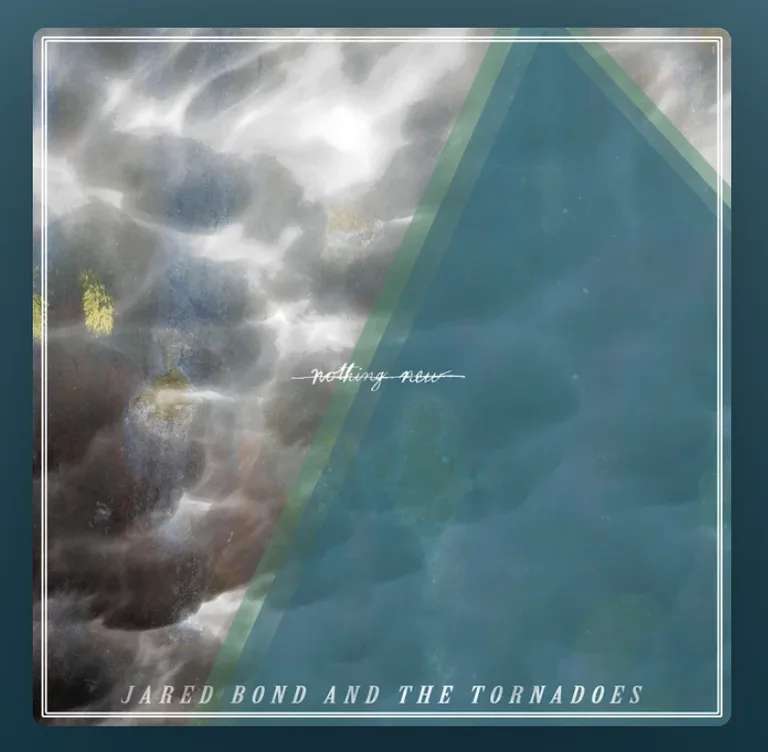

The Kansas City singer-songwriter revisits an archival five-track release shaped by spiritual doubt, exhausting work and creative uncertainty
Recorded more than a decade ago with his former band, The Tornadoes, Jared Bond’s Nothing New captures the difficult period that followed his time touring with Josephine Collective. The excitement of arena tours had given way to odd jobs, financial pressure and questions about whether creating music still had a purpose.
Across five tracks, the EP examines spiritual deconstruction, inherited behaviour and the repetition of working life. “Sour Wine” questions the religious beliefs Bond grew up with, while “Conduit” confronts the exhaustion of low-paid labour. The title track sits with creative stagnation, and “Break the Mold” asks whether people can escape the patterns shaping their lives.
Released on 15 August 2026, Nothing New preserves the immediacy of a band recorded live in the room. In this interview, Bond discusses the experiences behind the EP, his changing relationship with faith and why he has stopped trying to control how listeners receive his work.
Interview with Jared Bond
What inspired you to write Nothing New, and what was happening in your life at the time?
Ironically, it was a lack of inspiration that led me to write Nothing New.
This release is actually archival. I recorded it with my band, The Tornadoes, more than ten years ago, so I’m answering these questions from a little bit of distance.
At the time, I was in a strange place creatively and personally. I had just come off the road after touring with Josephine Collective. We were opening for bands on arena tours and meeting publicists, promoters, managers and all the other people who make that world go around. It was a pretty incredible fever dream, one of those periods that felt almost too good to be true.
When the touring stopped, reality set in. I had a new family to support and was trying to figure out how to build some kind of stable career outside music. I was working constantly at bars, Chipotle, delivering pizzas, UPS and pretty much any odd job I could find. I felt like I was giving my entire waking life to someone else, only to come home and wonder what any of it was for.
Looking back, most of the songs on this record came from a fairly dark place. “Conduit,” “Break the Mold” and the title track, “Nothing New,” all grew out of that period.
I was wrestling with spirituality at the same time. I was part of a generation that had become pretty disenchanted with organised religion, and I was deconstructing many of the beliefs I had grown up with. “Sour Wine” came directly out of that struggle.
What does the phrase “Nothing New” mean to you within the title track?
The phrase comes from the biblical idea that “there is nothing new under the sun.”
I was much more spiritually active at the time, and I think the original sentiment is actually less depressing than the way I use it in the song. To me, the biblical idea is more of a reminder to take it easy and recognise that, ultimately, nothing is really a surprise to God.
I took the phrase in a different direction. In the song, I use it more as a lament. It became a way of expressing the feeling that perhaps everything has already been said and done, and I’m simply trying to find some reason to keep making something anyway.
The EP blends indie rock, folk and singer-songwriter elements. How did you decide on its final sound?
I’ve never been very good at deciding what my music is supposed to sound like.
The more I try to come up with a target and deliberately hit it, the worse my art tends to get. I mostly want to write good words and good songs, then open the door and let other people help me figure out what they can become.
The Tornadoes were a very communal band, which was a big part of why that record sounds the way it does. I didn’t police what the other guys played, and they gave me the freedom to play the songs the way I did when I was sitting alone with a guitar. The final record was basically the collision of those things.
Joel Nanos also did a great job of capturing the sound of the band. We recorded all the instrumentation live, so a lot of the room and the interaction between the players is baked into those recordings.
Which lyric from the EP still feels the most personal to you, and why?
The song I still connect with most is “Sour Wine,” the opening track on the EP.
That song felt significant to me when I wrote it, and it still bears a pretty permanent mark on my soul. The whole thing is essentially a series of questions. I was doubting my beliefs and questioning what I had been taught, what I had actually learned and what I truly believed for myself.
I’ve always liked where the song eventually lands. At the end, I sing:
“I used to think you were watching us from above,
but since I found you’re not,
I have found you’re much closer than I thought.”
That still feels like an accurate description of my relationship with whatever it is that brought all of this into existence.
I don’t believe in a literal heaven or hell anymore, but I do believe we can cultivate something like heaven within ourselves. In many ways, we have the ability to make heaven or hell right here on Earth.
How did the songs change between their earliest versions and the finished recordings?
We never really made demos.
The songs were written on guitar, and they worked that way. Once we had them, the full-band arrangements came together through good old-fashioned practice. We played them until they felt tight, took them to Element Studios and recorded them.
There really wasn’t a grand production strategy behind it. We knew the songs, got into a room together and played them.
Sometimes the simplest process is the best one.
Why did “Nothing New” feel like the right title for the complete five-track release?
Honestly, it just felt clever to release a project called Nothing New.
It also captured how I felt at the time. I was pretty discouraged about creativity in general. I still felt this almost compulsive need to make things, but I was having a hard time finding inspiration.
There’s something appropriate about naming a record Nothing New when you’re struggling with the feeling that you have nothing new to say.
What would you like someone to feel or think about after listening to the EP?
I never really know how to answer this question.
I’ve learned that I have to let go of how other people receive my art. At most, I hope someone engages with it in some way. Perhaps it makes them sad or happy. Maybe they hear something that makes them feel understood. Maybe they hate it. I suppose all of those are legitimate ways of having a relationship with a song.
The minute I start worrying about something I have no control over, such as how someone should feel, whether they’ll like it or whether they’ll understand it, my art starts to suffer.
I try to make the thing as honestly as I can, put it out into the world and let it belong to whoever finds something in it.
Listen here, and follow the artist on Instagram: https://www.instagram.com/jaredbondmusic!
